AI Adoption Tower

Built for medium and large companies. Optimize for value delivered, not volume produced.

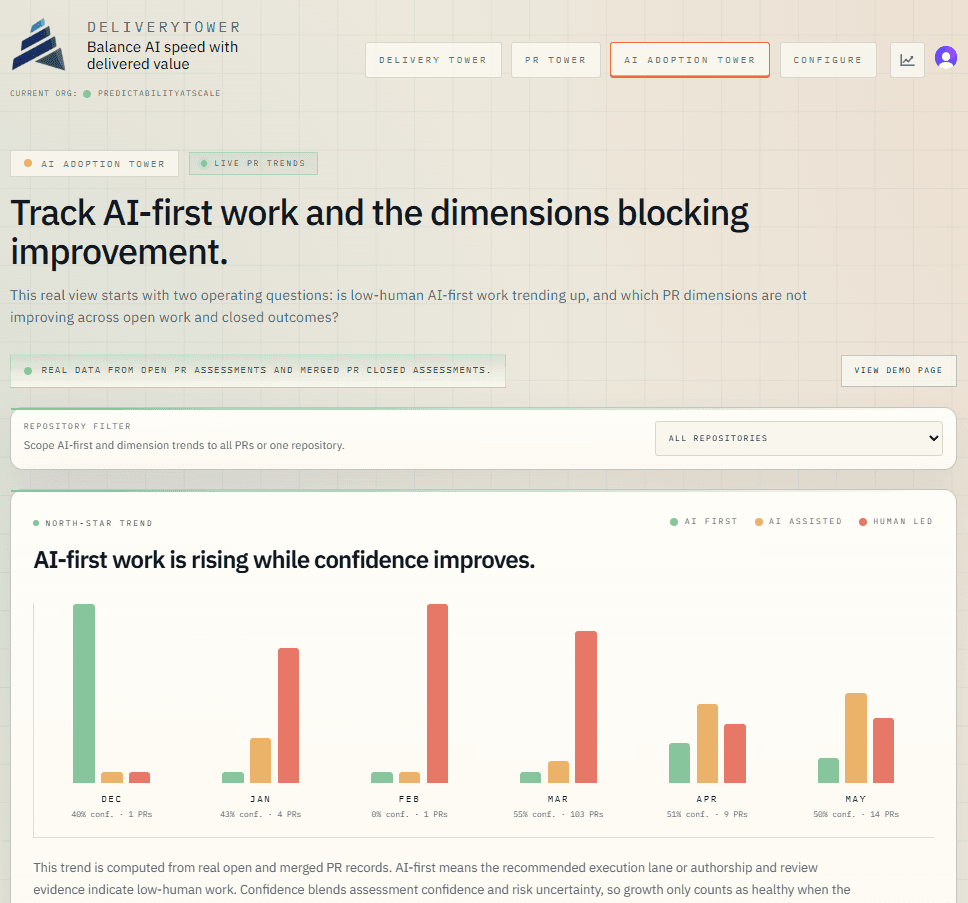
AI Adoption Tower proves AI delivery is getting better, not just bigger.

Organizations scaling agentic AI need to answer a harder question than “how much AI are we using?” They need to know: is AI building the right work, in the right lanes, with improving outcomes and decreasing hidden risk? DeliveryTower makes that question answerable with evidence.

Balanced adoption

62%

Completed work with material AI participation - measured against strategic fit and outcome quality, not just volume.

Safe execution

71%

AI-routed work shipped without elevated review churn, rollback, or corrective follow-on work - the real cost of unbalanced speed.

Lane accuracy

84%

Recommended execution lanes matched actual delivery behavior - proving the system routes work, not just labels it.

Risk concentration

3 hotspots

Negative signals cluster in a small visible set of domains - instead of being invisible until incidents surface.

Hero image showing a visually rich agentic engineering monitoring dashboard.

Enterprise reality

Prompt counts and token spend tell you nothing about whether AI is building the right things safely.

Enterprise reality

Governance stakeholders need to see where AI adoption is expanding into sensitive areas - before incidents reveal it.

Enterprise reality

Delivery managers need dashboards that measure judgment quality, not just raw activity or throughput.

Enterprise reality

Teams need actionable feedback on work shaping, verification readiness, and lane accuracy - not vanity metrics that reward speed alone.

Core views

Six views that separate real progress from activity theater.

The dashboard is intentionally opinionated. It separates adoption from effectiveness, effectiveness from safety, and safety from learning - because organizations that compress everything into a single score end up optimizing for the wrong thing.

Adoption overview

Measure AI adoption by value delivered, not prompts consumed.

Track assessed intake, lane mix, material AI participation, and adoption by team, repo, and work type. Separate genuine operating-model change from isolated experimentation so leadership sees the real adoption picture.

Illustration of an adoption overview dashboard with team and lane comparisons.

Delivery quality

Hold velocity accountable to friction, fixes, and downstream cost.

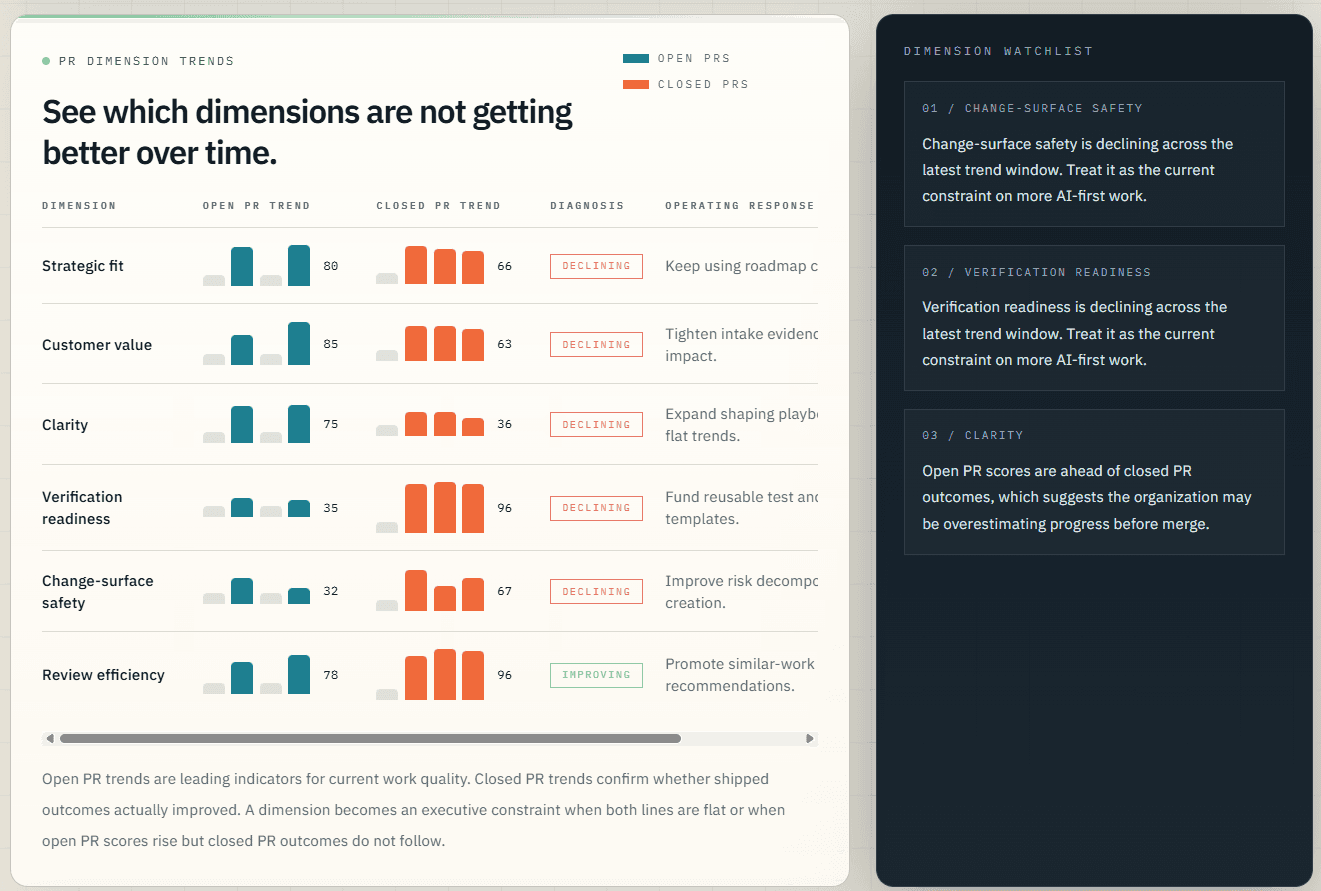
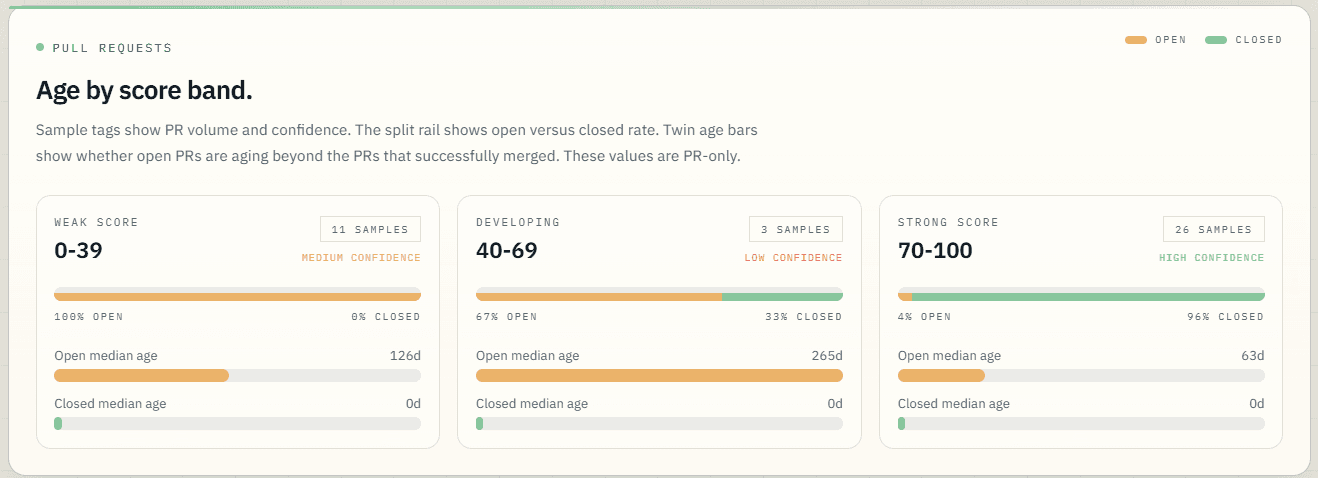
Compare AI-first, AI-with-review, human-shaped, discovery, and human-only lanes across completion rate, review friction, verification health, post-merge fixes, and rollback patterns. Speed that hides regressions isn't speed.

Illustration of delivery quality comparisons by execution lane.

Risk and policy posture

See where AI is expanding before governance finds out the hard way.

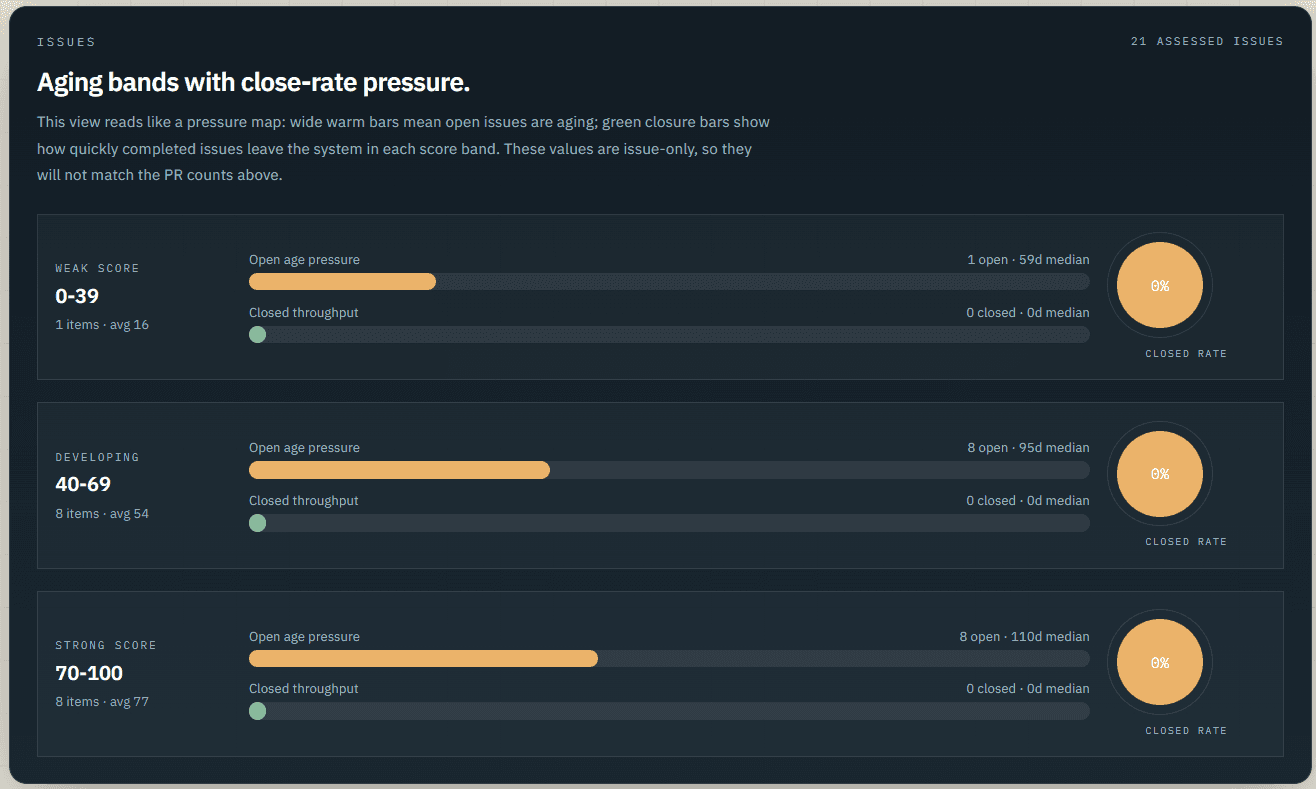
Surface AI-heavy execution in policy-sensitive or operationally critical domains, track whether mandatory human review is honored, and watch escalation patterns before they become incidents.

Illustration of a risk and policy posture dashboard showing concentration and review compliance.

Learning and calibration

Prove the operating model gets smarter, not just faster.

Show lane-accuracy trends, risk-underestimation rates, lesson reuse, and confidence calibration so the organization can trust that its AI delivery judgment improves with every completed delivery.

Illustration of learning and calibration trends for an agentic engineering dashboard.

Action queues

Convert insight into the next operating decision.

Surface teams ready for broader AI-first work, domains that need stronger verification, repeated shaping opportunities, and watchlists that delivery leadership can act on today - not review next quarter.

Illustration of action queues for expanding or constraining agentic engineering adoption.

Drilldown model

From leadership summary to item-level proof.

DeliveryTower is not vanity analytics. Every headline metric stays connected to real work items, lane recommendations, delivery evidence, and hindsight signals - so users can verify the claims and challenge the judgment.

01

Organization view

Executives get a portfolio-level posture summary of adoption, effectiveness, safety, and learning.

02

Portfolio and team view

Delivery leaders compare teams, programs, and repositories to see where adoption is healthy, stalled, or risky.

03

Domain and work-class view

Engineering managers isolate differences in readiness, boundedness, review burden, and recurring failure patterns.

04

Item evidence view

Users drill to representative work, original lane recommendation, delivery evidence, and hindsight feedback without trusting a black box.

Required comparisons

01

By execution lane: AI First, AI with Human Review, Human Shape + AI Build, Needs Discovery, Human Only.

02

By team or project: identify leaders, laggards, and places where risk is gathering.

03

By repository or system area: spot bounded technical domains versus fragile ones.

04

By work type: compare bugs, infra, UI, tooling, data work, and sensitive changes.

05

By time window: view the last 30 days, last quarter, and trailing 12 months without conflating them.

Why this matters

The organizations that win with agentic AI will be the ones that optimize for value, not just velocity.

DeliveryTower helps enterprises see whether AI-assisted delivery is expanding in the right work classes, improving quality, reducing avoidable human review load, and learning from outcomes - instead of repeating the same mistakes at larger scale and higher speed.

All products

Leadership

See whether AI adoption is delivering strategic value, not just higher throughput that hides risk concentration and quality erosion.

Delivery managers

Compare lane accuracy, review burden, verification health, and outcome quality to identify where the operating model is working and where it needs adjustment.

Governance

Track policy-sensitive domains, escalation trends, rollback risk, and human-review compliance as AI adoption scales - with evidence, not assumptions.

Practitioners

Improve work shaping, verification readiness, and lane selection using examples from real deliveries - the fastest path from good-enough to genuinely AI-ready.