Agentic AI engineering, balanced

Fast isn't the hard part anymore. Right is.

Plan Mode for Companies, Products, and Projects

DeliveryTower is the control tower for AI-scaled product delivery. It helps teams decide what AI should build, what humans should shape first, and what should merge now-using strategy fit, verification strength, change risk, and delivery history instead of guesswork.

Live scoring previewRadar telemetry

AI Deliverability Score

Feature 1Feature 2
20406080100StrategyValueClarityVerifiabilitySafety

Compare multiple work items side by side to see how they score across strategy, value, clarity, verifiability, and safety.

The shift

Capacity is abundant

The bottleneck moved from “can we build it” to “should we build it, and can we trust the outcome.”

The system

Three towers

Assess incoming work. Prioritize pull requests. Monitor AI adoption. Each tower optimizes a different dimension of agentic engineering.

The answer

Balanced optimization

Optimize speed, strategic value, quality, and safety together - not one at the expense of the others.

Product suite

Three towers that turn AI throughput into organizational value.

Each tower addresses a distinct challenge in agentic AI engineering: assessing and routing incoming work, prioritizing pull request review, and proving that AI adoption is improving outcomes - not just accelerating output.

Assess · Route · Learn

Delivery Tower

Turn backlog items into delivery-ready work packets.

Score every issue against strategic fit, verification readiness, change-surface risk, and hidden follow-on cost. Route to the right execution lane - AI-first, human-shaped, or discovery - so the organization builds what matters, safely, and learns from every delivery.

4 execution lanes, 12+ assessment signals
Evidence-backed routing decisions
Closed-loop learning from delivery outcomes
Learn more
Prioritize · Recommend · Accelerate

PR Tower

Surface the PRs that deliver the most value first.

Score every open pull request against strategic alignment, customer impact, change-surface risk, and verification readiness. Replace FIFO review queues with priority-ranked lists, and surface similar-work review recommendations so reviewers catch known issues before they repeat.

Priority ranking by delivery value, not arrival time
Similar-work recommendations from historical patterns
AI-assisted review that learns from your team's history
Learn more
Monitor · Compare · Prove

AI Adoption Tower

Prove AI delivery is getting better, not just bigger.

Track balanced adoption, safe execution, lane accuracy, and risk concentration across teams, repos, and work types. Give leadership evidence-backed answers to the harder question: is AI building the right things, in the right lanes, with improving outcomes?

Six opinionated dashboard views
Drilldown from portfolio summary to item-level proof
Adoption measured by value delivered, not prompts consumed
Learn more

Feedback loops

Every delivery makes the next scoring and review decision better.

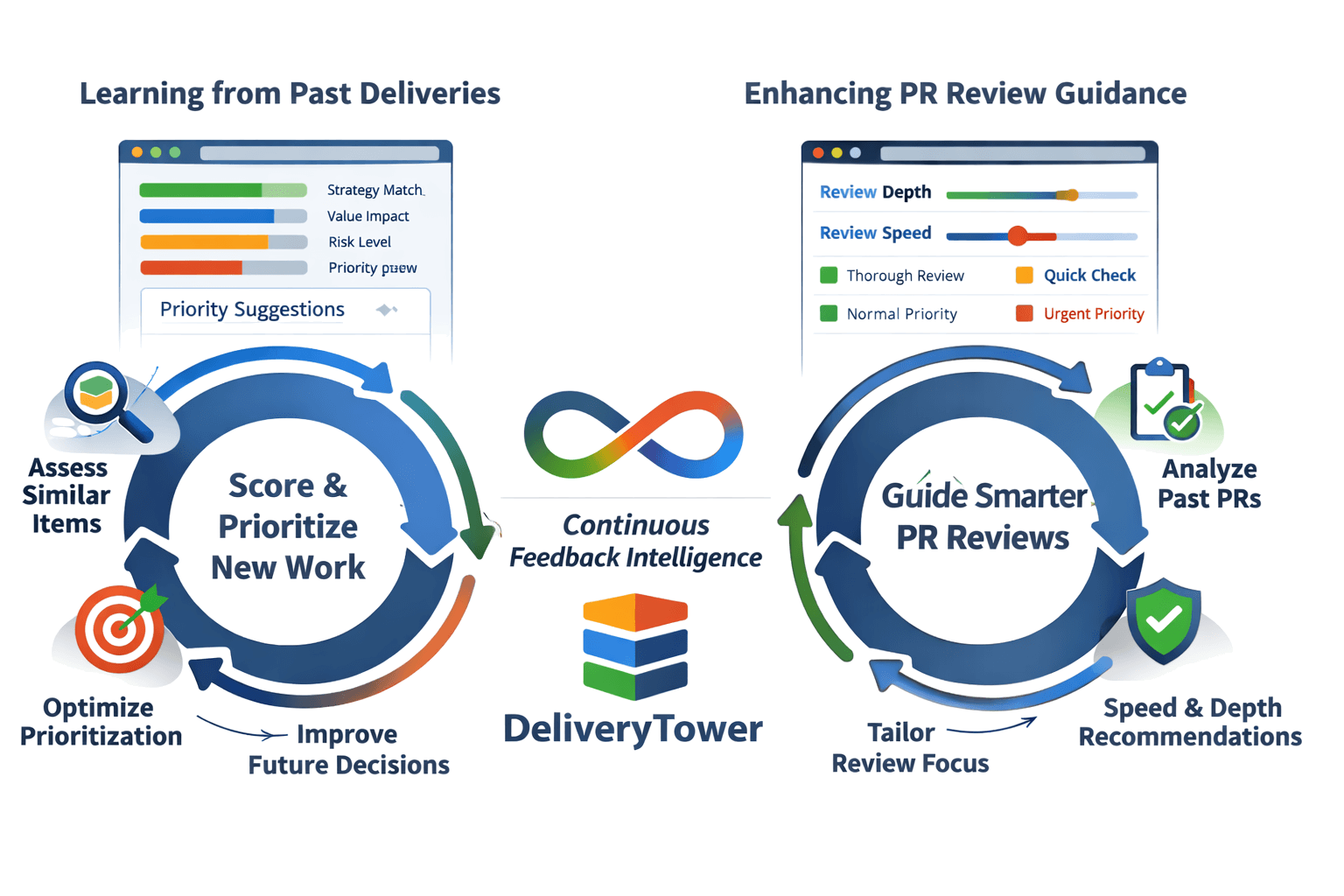
DeliveryTower gets stronger when work ships. It uses outcomes from delivered issues and completed pull requests to improve future prioritization and review guidance instead of repeating the same judgment calls from scratch.

01. Issue scoring learns

Score new issues with the context of similar delivered work.

When teams deliver similar issues, DeliveryTower can reflect on those outcomes to sharpen scoring across strategy, value, clarity, verifiability, and safety. That history helps new work get prioritized with more evidence and less guesswork.

02. PR guidance improves

Use prior delivered issues to recommend review depth and speed.

Past delivered issues and their resulting pull requests provide patterns for how much review a new change deserves. DeliveryTower can use that history to suggest when a PR needs deeper scrutiny, when it can move quickly, and where reviewers should focus first.

Diagram showing how delivered work improves future issue scoring and pull request review guidance
New articlePDF download

The future of AI engineering is not more code, but better decisions about what gets built

A short argument for why AI changes the engineering bottleneck from implementation capacity to judgment, prioritization, and safe routing.

New in Delivery Tower

Interactive prioritization that adapts to your strategy.

Weight scoring dimensions in real time — emphasize customer value, strategic fit, delivery safety, or readiness — and watch the ranking reorder instantly. Three radar visualizations reveal where items cluster and where they diverge.

Nested Priority Rings

Onboarding ExperienceStripe marketplace AppHome Page ImprovementsSurvey EmbeddingUse-Case Page Set
StrategyValuePriorityClarityVerifySafetyAI Fit

Why it matters

A single rigid score can't capture shifting business context. When a customer escalation lands, you need to foreground customer value. When a release is days away, verification readiness and delivery safety dominate. Interactive weighting gives leaders a live instrument panel — not a frozen spreadsheet.

Weight & Lock

7 dimensions, 1 constraint

Drag any slider to emphasize a dimension. Lock the ones that must stay fixed. The rest rebalance to 100% automatically.

3 radar modes

Visualize trade-offs

Constellation overlays, nested priority rings, and portfolio heat maps reveal where items cluster and diverge.

The discipline layer

Agentic AI engineering means optimizing for value, not just velocity.

DeliveryTower sits above the coding agent. It ensures every AI-built change is strategically aligned, well-understood, safely routed, and verified - so organizations scale AI delivery without accumulating hidden risk, regressions, or strategic drift.

Why balanced optimization wins

Because raw throughput without judgment creates regressions, scope sprawl, and strategic drift faster than teams can absorb.

Because the organizations that win with AI will be the ones that build the right things safely - not just more things quickly.

Because a system that learns from delivery outcomes gets better every sprint, while a system that only optimizes for speed repeats the same mistakes at scale.

Explore the towers